
This post continues our series exploring the most potent weapons for influence. To make the most of the series, start with the foundational post and follow through.
In a few words, we face many decisions and situations every day and don’t have the time, energy, or capacity to think through each one. So, we evolved to have our intuitions guide us instead of reasoning everything. Because our intuitions respond automatically to situations, they are vulnerable to influence.
The key intuitive principles we all use, which are potent for influence, evolved with us. They helped us develop effective groups that outcompeted rivals. Such groups survived to form the societies we have today. As such, we have the principles encoded in our genes and are present from birth. We reinforce them by learning from the norms in our communities.
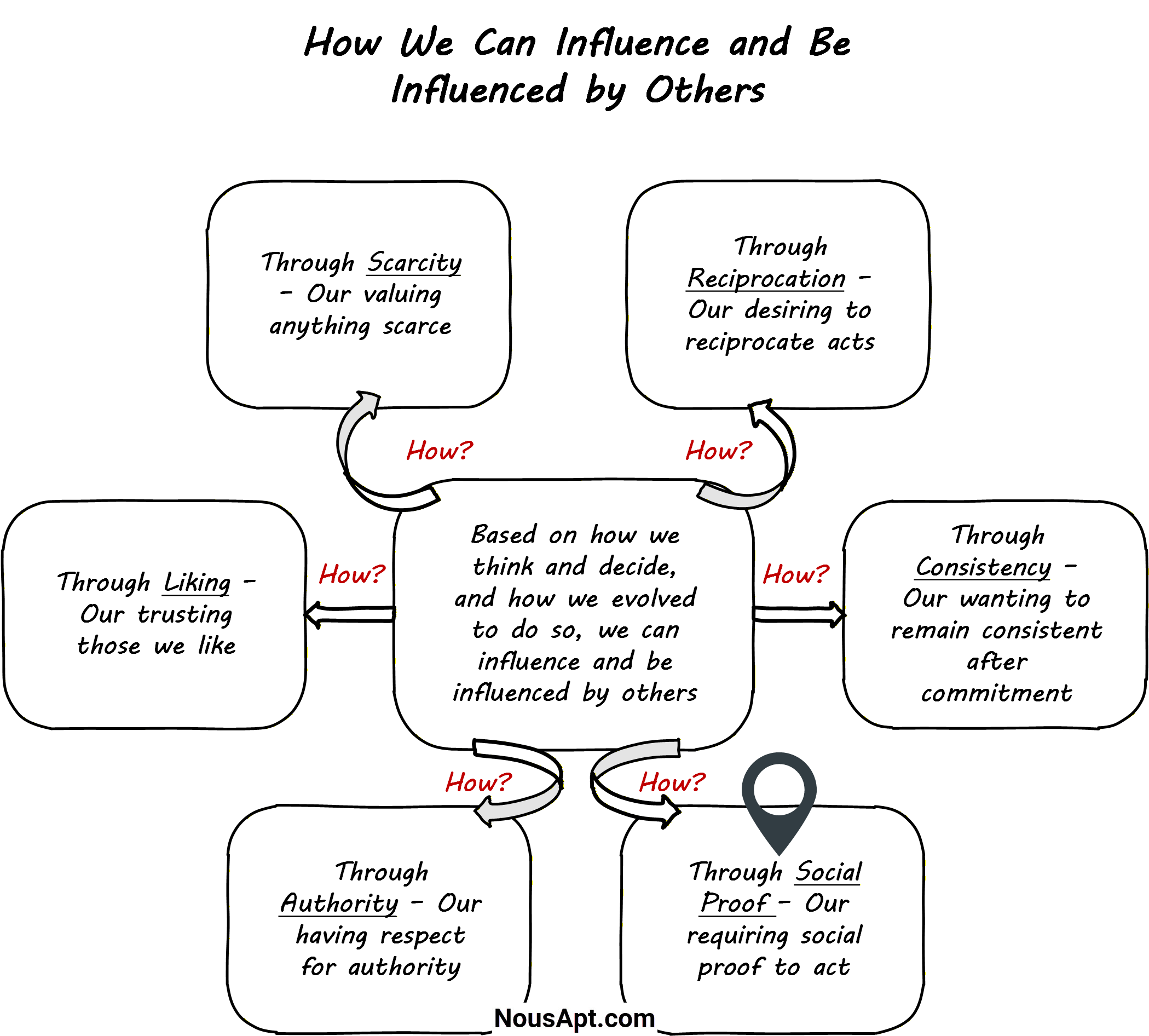
In “Influence: The Psychology of Persuasion,” Robert Cialdini outlined these principles of influence as:
- Reciprocation – Desiring to reciprocate acts
- Consistency – Wanting to remain consistent after commitment
- Social Proof – Requiring social proof to act
- Authority – Having respect for authority
- Liking – Trusting those we like
- Scarcity – Valuing anything scarce
In this post, we will explore social proof. But before we do, you really should read the foundational post if you haven’t. It further examines the link between our mental shortcuts and influence.
Subscribe for the Full Experience, It’s Free
View the complete post with deeper insights, practical applications, key takeaways, and more. Plus, you can download the post as a PDF document for printing or offline reference.
Subscribe once and gain access to other exclusive resources on the website and in your inbox.
Social Proof – Requiring Social Proof to Act
Why do skit makers on social media use laughter sound effects in their skits?
They use them because they make their audience laugh. Cialdini noted what the research says. Experiments found that playing recorded laughter causes the audience to laugh longer and more often when presented with amusing materials. They also rate such materials as funnier.
Not only that, but some evidence also indicates that recorded laughter is most effective for poor jokes.
So the skit makers’ actions make perfect sense. Adding laugh tracks to their skits makes them funnier, especially when the material is of poor quality.
The question then is, why do such sound effects work on us the way they do?
To understand why pre-recorded laughter is so effective, we first need to grasp the principle of social proof, another potent weapon of influence.
It states that one way we learn what is correct is to observe what other people think is correct.
The principle applies especially to the way we decide what constitutes correct behavior.
We view a behavior as more correct when we see others performing it. The greater the number of people engaging in such behavior, the more we view it as correct.
Whether the question is:
- What to do at a traffic stop,
- What we do with empty soda cans,
- How we greet elders in a different culture, or
- How to eat the food served at a wedding party,
The actions of others around us are essential in defining the answer.
Our tendency to see an action as more appropriate when others are doing it tends to work quite well. As a rule, we will make fewer mistakes by acting in line with social evidence than contrary to it. Usually, when many people are doing something, it is the right thing to do.
So, just like the other weapons of influence, social proof serves as a shortcut for determining how to behave. But it also makes the shortcut user vulnerable to those who wish to exploit the situation for influence.
Scammers who hack social media accounts exploit social proof to scam others and profit.
Typically, a hacked account is used to promote a fraudulent scheme in which others (or bots) working with the scammer drop comments testifying to having benefited from the scheme. These comments serve as social proof for others that the scheme works and is okay to join.
Subtle Use in Everyday Business and Settings
While these scams represent extreme cases, the same principle is used more subtly in everyday business. Indeed, our tendency to assume that an action is more correct if others are doing it is exploited in a variety of settings.
Advertisers love to tell us that a product is the ‘fastest-growing’ or ‘largest-selling’ because they don’t have to convince us directly that it’s good. They only need to say that many others think so, which seems proof enough.
Physical venues are not left out. Nightclub owners simulate a vibrant club night with central tables occupied by invited clubbers early in the night to attract other drinking customers.
Eliminating Undesirable Behaviors
Researchers have also used the principles of social proof in procedures, sometimes with remarkable results.
One psychologist in particular, Albert Bandura, had led the way in developing such procedures for eliminating undesirable behavior.
Bandura and his colleagues have shown how people suffering from phobias can be rid of these extreme fears straightforwardly.
For instance, in an early study, nursery-school-age children selected because they were terrified of dogs watched a little boy play happily with a dog for 20 minutes a day.
This display produced noticeable changes in the fearful children’s reactions. After only 4 days, 67% of them were willing to pet and scratch a dog alone while everyone else left the room.
Moreover, when the researchers tested the children’s fear levels again one month later, they found that the improvement lasted. In fact, the children were more willing than ever to interact with dogs.
An important practical discovery was made in a second study of children who were also afraid of dogs. To reduce their fears, it was not necessary to provide a live demonstration of another child playing with a dog. Film clips had the same effect. And the most effective type of clip was one with several other children playing with their dogs.
So it seems, once again, that the principle of social proof works best when the proof comes from the actions of many others.
Without question, the powerful influence of filmed examples on children’s behavior can also apply to various problems.
Condition Under Which Social Proof Works Best
Of course, social proof, like other weapons of influence, works better under certain conditions. If we are to make the most of it or to defend ourselves against its exploitation, it is key that we know these conditions.
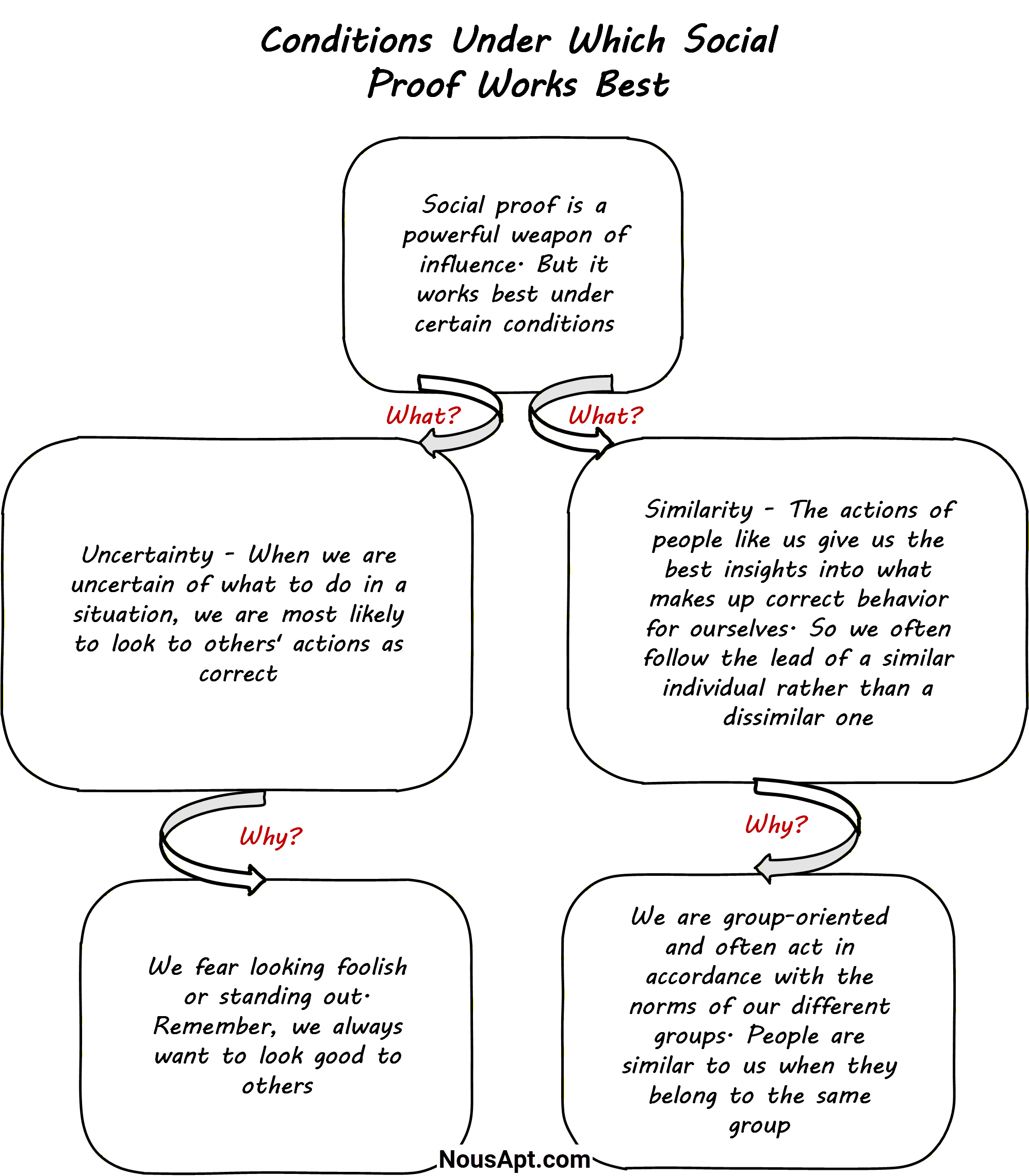
The conditions under which social proof works best include:
- Uncertainty
- Similarity
Uncertainty
Social proof works best when we are unsure of ourselves. When we are uncertain of what to do in a situation, we are most likely to look to others and accept their actions as correct.
In examining others’ reactions to resolve our uncertainty, however, we are prone to overlooking a subtle but critical fact. Those people are probably looking to others as well. Cialdini noted that:
- Especially in an uncertain situation, the tendency for everyone to be looking to see what everyone else is doing can lead to a fascinating phenomenon called pluralistic ignorance.
Pluralistic ignorance is a phenomenon in which most people in a group privately and wrongly assume what others in the group are thinking or doing.
So, they may disagree with a norm or belief but mistakenly assume that most others in the group accept it. This leads them to publicly conform to a norm they actually dislike.
This misperception, often driven by fear of looking foolish or standing out, leads to actions contrary to personal values, contributing to:
- The bystander effect,
- Reinforcing unpopular norms (such as heavy drinking on campus), and
- Hindering positive social change.
The Bystander Effect
An understanding of the pluralistic ignorance phenomenon helps to explain the bystander effect. The bystander effect refers to the failure of an entire group of bystanders to aid victims in serious need of help.
Psychologists think that there are at least two reasons a bystander to an emergency would be unlikely to help when many other bystanders are present.
The first reason is rather straightforward. With several potential helpers around, each individual’s personal responsibility is reduced. Everyone assumes, perhaps, that someone else has already called for help. So, with everyone thinking that someone else will help or has helped, no one does.
The second reason is quite interesting. It involves the pluralistic ignorance phenomenon, which is founded on the principle of social proof.
So, because we all want to look good to the other bystanders around, we take discreet glances around to gauge their reactions. When we see everyone else looking calm, we interpret the situation as a non-emergency and do nothing.
This, according to Bibb Latane and John Darley in their influential journal article, is the state of pluralistic ignorance in which each person decides that since nobody is concerned, nothing is wrong.
In the meantime, the danger may be mounting. At some point, an individual not influenced by others’ seeming calm would react and do the needful.
Note that the bystander effect happens when bystanders are strangers and cannot be sure that the event they are witnessing is an emergency.
In such a situation, a victim is much more likely to be helped by a lone bystander than by a group. This is especially so if the people in the group are strangers to one another.
What to Do As a Victim in a Situation Liable to the Bystander Effect
When you are in a situation with a possible bystander effect, you must do more than alert bystanders to your need for emergency assistance. You must remove their uncertainties about how to provide that assistance and who should provide it.
But what would be the best way to do so?
Your best bet is to isolate one individual from the crowd. Stare, speak, and point directly at that person, not at anyone else. Then, ask for that person’s help. With that, you should remove all uncertainties that might delay or prevent you from getting help.
The person should now understand that emergency aid is needed. He should understand that he, not someone else, is responsible for providing the aid. And, finally, he should understand exactly how to provide it.
All the scientific evidence shows that the result should be quick, effective assistance.
Similarity
Another condition under which the principle of social proof works best is similarity.
The principle of social proof is most powerful when we observe the behavior of people like us. It is the actions of such people that give us the best insights into what constitutes correct behavior for ourselves.
Therefore, we are more inclined to follow the lead of a similar individual than a dissimilar one.
As Cialdini noted, research suggests this important qualification of the principle. We use others’ actions to guide our own behavior, especially when we view them as similar to ourselves.
This tendency applies not only to adults but also to children. We frequently think of teenagers as rebellious and independent-minded. It is important to recognize, however, that this is typically true only with respect to their parents. Among similar others, they conform massively to what social proof tells them is proper.
Indeed, we look to others similar to us for the most relevant information about what we could or should do.
This is also supported by research findings as reported by Everett M. Rogers in his seminal book, “Diffusion of Innovations.“
Rogers reported that most people do not evaluate an innovation based on scientific studies or its consequences. But such objective evaluations are not entirely irrelevant, especially for the very early adopters.
Instead, most people rely primarily on the subjective evaluation of other people like themselves who have already adopted the innovation.
How to Say No
How can we expect to defend ourselves against social proof, a powerful weapon of influence that influences so many aspects of behavior?
Adding to the problem is that we most often need the information social proof provides. Indeed, the evidence it offers about how we should act is usually valid and valuable. It allows us to make decisions intuitively without reasoning through everything we encounter.
Fortunately, there is a way out of the dilemma.
Because it’s the information that social proof provides that is important, we can do well against it by focusing on such information.
If we become aware of situations in which social proof relies on inaccurate information, we can counter it as needed.
Cialdini identified two types of situations in which incorrect data makes social proof unreliable.
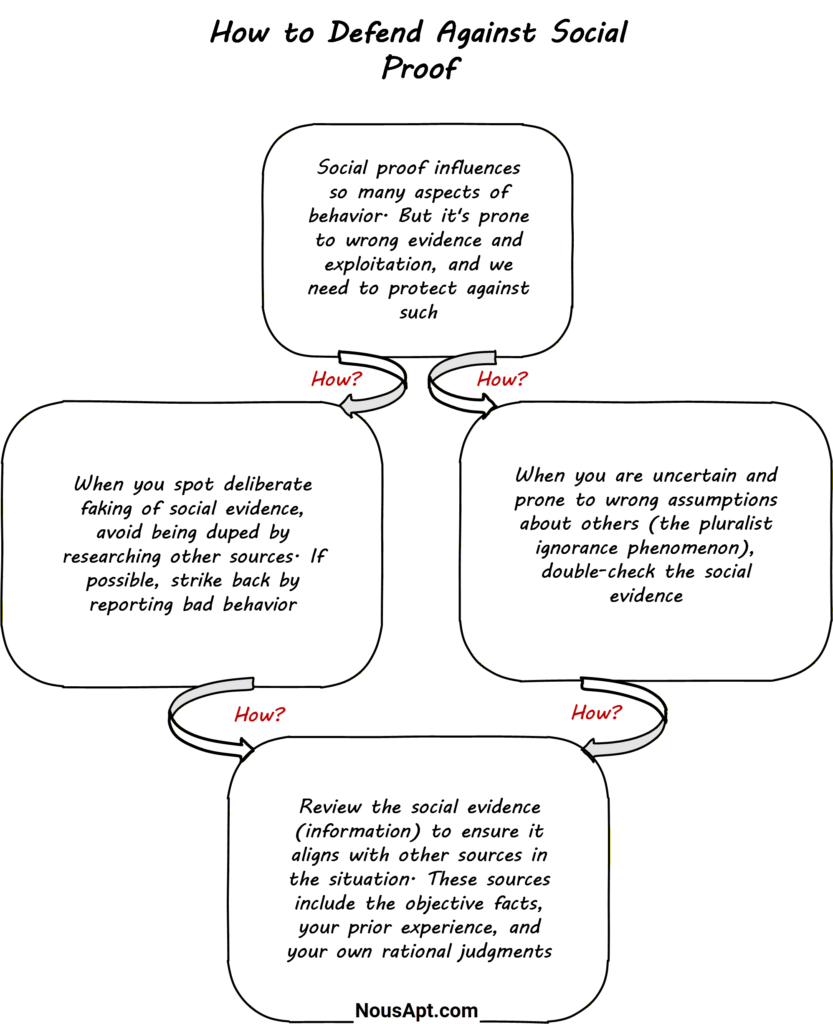
The first occurs when the social evidence has been purposely falsified.
Exploiters always manufacture such situations to create a false impression. They do that to convince us, regardless of reality, that a multitude is behaving the way the exploiters want us to behave.
Whenever you encounter this influence attempt, i.e., you spot fakery, avoid being duped by researching other sources. And if possible, strike back by, for example, reporting the bad behavior.
Besides situations where social evidence is deliberately faked, there is another situation where social proof regularly steers us wrong. At such times, an innocent, natural error snowballs into social proof that pushes us toward the wrong decision.
The pluralist ignorance phenomenon, in which everyone makes mostly wrong assumptions about others, is one example of this process.
It is worth repeating that we seem to assume that if many people are doing the same thing, they must know something we don’t.
Especially when we are uncertain, we are willing to place great trust in the crowd’s collective knowledge. Quite frequently, the crowd is mistaken because they are not acting based on any superior information but are reacting, themselves, to the principle of social proof.
Learn to Review Social Evidence
There is a lesson here. A shortcut device, such as social proof, should never be fully trusted. Even when no exploiter has fed bad information into the mechanism, it can sometimes go haywire on its own.
We need to review the social evidence to ensure it aligns with the other evidence sources in the situation. These sources include:
- The objective facts,
- Our prior experiences, and
- Our own rational judgements.
Fortunately, taking this precaution requires little effort or time. A quick glance around is all that is needed. And this little precaution is well worth it. The consequences of single-minded reliance on social evidence can be frightening.
Conclusion
Indeed, social proof is a powerful weapon of influence.
We (humans) evolved to use it as a shortcut to navigate a complex world. It helps us learn social norms and coordinate with others. But when used blindly or dishonestly, it can also mislead us, suppress independent thinking, and reinforce harmful behavior.
To make the most of social proof while mitigating its downsides, we should learn to review it.
Learn to pause and assess the quality of the social evidence, then combine such with objective facts, our own experience, and personal judgment. By doing so, we gain the best of both worlds:
- The efficiency of intuition and the accuracy of reasoning.
Understanding social proof makes you a better leader, and perhaps, a more ethical marketer. It definitely makes you a sharper decision-maker and a harder person to manipulate.
If you found this post helpful, imagine how much more value you will get from it as a subscriber. Plus, you can download the post as a PDF document for printing or offline reference.
Lastly, you will love our newsletters where we share exclusive resources with subscribers. Subscription is free.
To share your views on this post, take the discussion to your favorite network. Use the share buttons below.

I am the managing director of Proedice Limited where we help organizations and individuals get remarkable results from entrepreneurship, innovation, and marketing. I am constantly learning and always looking to make a positive impact.